


Blog
Open Your Home to the World: Host an Exchange Student from Switzerland, Argentina, France or the USA
Becoming a host family for an international exchange student in Australia or New Zealand is an opportunity to welcome a new culture into your everyday life, share your family traditions and build a connection that can last well beyond the exchange.

Blog
Every Exchange Has a Story: YFU Australia & New Zealand at Made Impact in New York
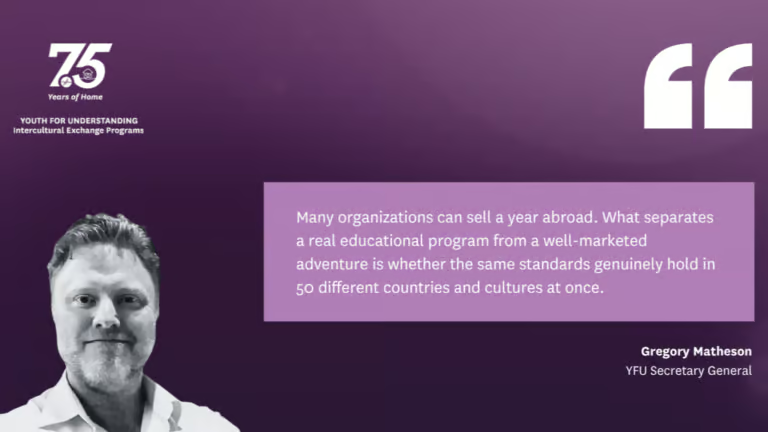
A successful exchange is not simply about travelling to another country. It is about a young person arriving safely, being welcomed by a prepared host family and community, receiving support when challenges arise, and returning home with greater confidence, maturity and understanding of different perspectives.
Blog
Changing the World Through Young People: The Leadership Behind YFU
A successful exchange is not simply about travelling to another country. It is about a young person arriving safely, being welcomed by a prepared host family and community, receiving support when challenges arise, and returning home with greater confidence, maturity and understanding of different perspectives.

Alex Liddell
5 months ago
I did an exchange year with YFU to Switzerland in 2024-2025, and it was the best experience of my life. The support I received from YFU throughout the whole process was amazing and made everything seem a lot less overwhelming than it felt at times. I got to make best friends all over the world and learn a new language. I highly recommend YFU to anyone thinking about doing an exchange!!

Don Sie
12 months ago
Our family hosted a Norwegian student for a year through YFU. The student fitted in with the family so well, and we received all the support we needed from YFU. We now have a lifelong friend in Norway

Felicity Dascombe
12 months ago
Our daughter Hannah has travelled to the USA with YFU for 12 months, living with a local family and attending high school there. She has loved every minute of the experience. Her host family welcomed her as one of their own, and she has had incredible opportunities, great experiences, and made lifelong friends. We are very grateful to YFU for making this possible.

Carmel Humphries
12 months ago
If you are thinking about hosting an international student, this organisation is great! They do genuinely support the host family as well as the student, guiding everyone to have a positive experience in Australia. Hosting gives you the best opportunities to explore your own backyard and see it with new eyes! While all students (and host families) are different, YFU's works with them to develop their understandings and realistic expectations. YFU families come in all shapes and sizes and mine is now spreading further around the world with each young person who stays awhile in my home but much longer (maybe forever) in my thoughts and beyond.

Belinda Young
1 year ago
Our family have had the privilege to host 4 young people so far. We really enjoy hosting and now have 4 new family members. We count them as sons/daughters, brothers/sisters. Our first 2 students have returned to visit us and our family has had the opportunity to visit 1 of our students and meet their family. YFU support us through the process and have always been there to help when we needed it.

Tracey Steele
1 year ago
We’ve now hosted two wonderful students through YFU and loved every minute. Our family has welcomed both a Norwegian and an Argentinian student, and they fitted in straight away. The support from YFU as a host family has been excellent, and we always felt comfortable reaching out with questions.
Hosting has given our children lifelong friendships — my younger son enjoyed having “sisters” at school, and my older son is even visiting our Norwegian student’s family while travelling in Europe.
Hosting has given our children lifelong friendships — my younger son enjoyed having “sisters” at school, and my older son is even visiting our Norwegian student’s family while travelling in Europe.

Glen Burgess
1 year ago
Our family had a great experience with YFU Student Exchange. Our daughter participated in a "one school term" experience in Canada. She was placed with a beautiful family who provided her with a memorable experience of Canadian life and culture. So much so, she didn't want to come home. Pamela and Melanie from YFU exchange were professional and provided great communication and support through the process. They settled our nerves, with regular contact, while allowing our daughter to take responsibility of the her great adventure through different stages of the exchange. We highly recommend YFU Student Exchange to other families thinking of this experience.

Asha Condie
1 year ago
Hello, My name is Asha I did an exchange to Belgium for a year when I was 15. It's pretty hard to sum up this experience because there's just so much you want to talk about, best time of my life says it pretty well! I loved meeting the other like minded teenagers from all over the world who become my family. I moved host families once due to complication in the family but after that i was placed with the most amazing family who took care of me and where so interested to learn about my country. Schooling and lifestyle was so different to my home life which just made everything so exciting and new. learning the language is hard but if you get practice before you depart you'll be fine. If your looking at this and you think this would be something for you, it isn't for everyone but encourage so much to just go for it. Live a big life even if your just 15 🙂

Hernan Chanique
1 year ago
As a former YFU exchange student, I can say this was one of my most important experiences. YFU is a reliable, trustworthy organisation with many years of experience uniting people from all over the world.

Ned Goodwin
1 year ago
I was an exxhange student as a youth and it changed my life, positively and irrefutably. My daughter opted to venture to Argentina of her own volition decades later with the same ideals in mind: to open her mind to a diverse and beautiful world in a quest for empathy. She, too, had a thrilling and enriching experience. I can't recommend YFU highly enough for those with an open mind seeking something far beyond the limiting back yard.

Michaela Read
7 years ago
Most amazing team helping youth and their families experience incredible country and cultural exchanges.